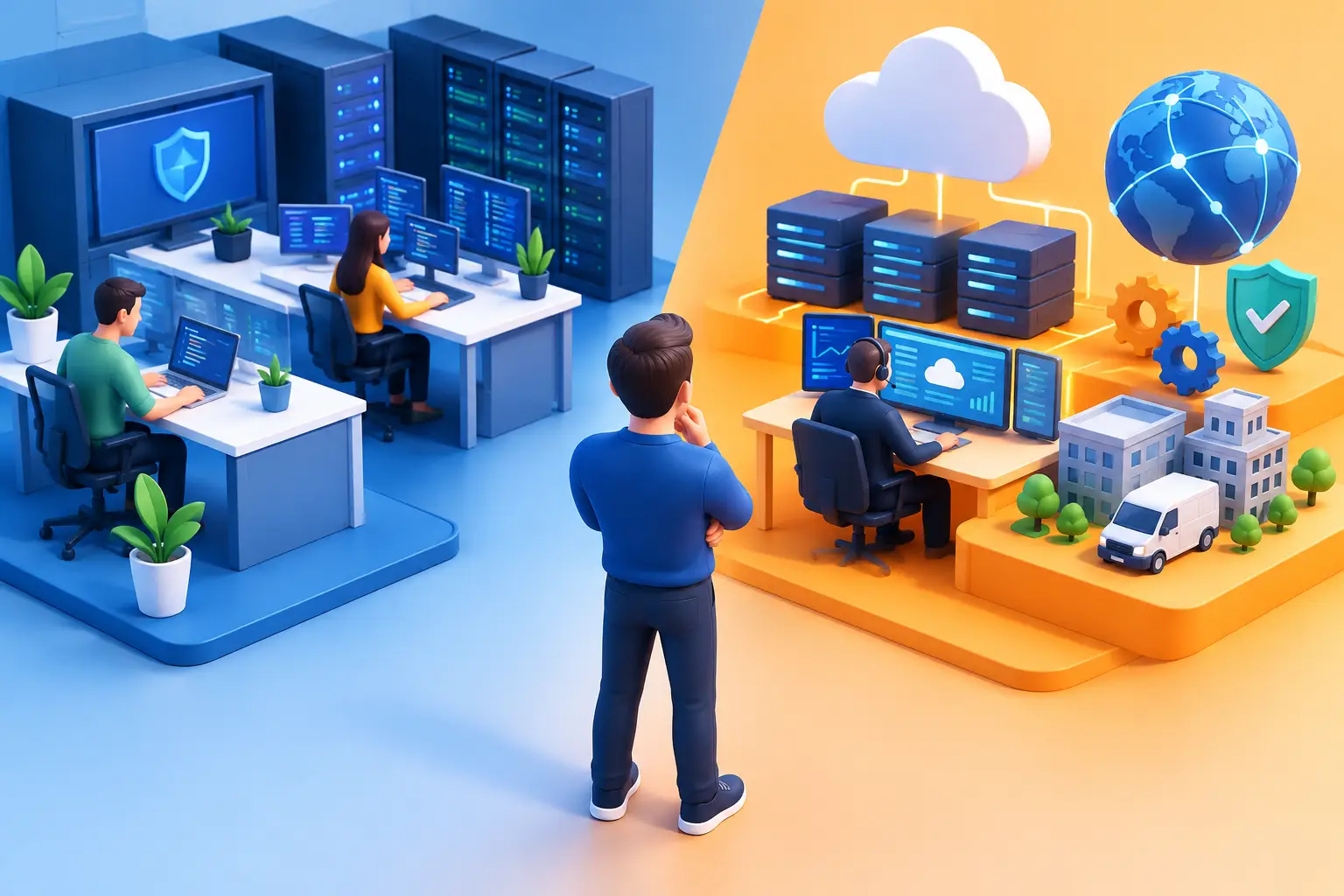
Internal IT or Service Provider?
When a key IT employee is on holiday, sick or has left, a single unresolved access issue can halt an entire department. The question of internal IT or service provider then becomes non-theoretical. It’s about whether the company can continue to serve customers, protect data and support its staff without unexpected costs or prolonged disruptions.
The right answer is not determined solely by the size of the company. It depends on how reliant operations are on technology, how sensitive the data is, how fast changes occur, and what responsibility management wants to bear itself. Some companies need a strong internal team. Others receive better service, greater oversight and more predictable costs from a service provider. Many gain the most benefit from a combination of both.
Internal IT or Service Provider: What’s at Stake?
An internal IT team often knows the staff, business systems and workflow from firsthand experience. It can be located close to operations, participate in prioritisation and respond quickly to specific needs. For companies with highly specialised systems, significant in-house development or a complex technological environment, this knowledge can be invaluable.
But an internal team doesn't automatically equate to continuous service. One or two employees can rarely be experts in network operations, cloud environments, user support, security monitoring, backups, regulatory compliance and disaster recovery plans simultaneously. When daily service requests take up the whole day, long-term work is often left behind: updating access controls, testing recovery, asset inventory and risk assessment.
A service provider takes on defined or extensive responsibilities under contract. This can include device monitoring, user support, Microsoft environment management, security defences, backups and consulting. The company then buys not a single person, but a team, procedures and tools designed to keep the environment stable.
However, this doesn't mean a service provider should have free rein without clear expectations. Good service is based on shared responsibility, defined priorities, regular communication and a clear understanding of who approves changes. The service provider should simplify technology, not add another layer of uncertainty.
The cost is greater than the salary
A common mistake is to simply compare a monthly service fee with the salary of an IT employee. Salary is only part of the cost. Added to this are recruitment, training, absence, workplace, leave, specialised security tools and the time spent keeping knowledge up-to-date. If an employee leaves, the company can also lose context, documentation and key access if management has not been in order.
With an operator, costs often become more predictable. The company has a better idea of the costs of daily administration, support and security monitoring, and is less likely to have to react with expensive emergency purchases when equipment fails or an attack occurs. However, predictable pricing is only a real benefit if the contract defines what is included and what counts as additional work.
So don't just ask: What does the service cost per month? Rather, ask: What does an hour of downtime, a lost contract, an inaccessible accounting system or data loss cost? A company that relies on email, file storage, cloud systems and remote connections can lose more from a single serious incident than it saves by postponing necessary administration.
Security requires daily attention
Cybersecurity is not a product that is set up once and then forgotten. New devices are added, employees come and go, passwords leak, software needs updates, and phishing emails become more convincing. Security is based on recurring tasks that require ownership.
An internal team can handle this well when it has enough time, the right expertise and a clear mandate. In practice, however, security tasks often become a secondary priority when staff need immediate assistance. Then simple things can become weaknesses: inactive accounts after leaving employment, devices that have not been updated, untested backups or users with more rights than they need.
An operator can bring standardised processes and specialised tools to monitor devices, protect endpoints, manage passwords and analyse anomalies. But tools alone do not protect the company. Most importantly, someone must follow up on warnings, fix vulnerabilities and be able to explain to management what the risk means for the business.
When we take responsibility for a client's operations at nexIT, we emphasise this continuous oversight. The goal is not to collect disparate solutions, but to ensure that devices, users, backups and defences work together so that the company can continue even if something goes wrong.
Service speed and operational understanding must go hand in hand
Staff primarily value IT based on whether they can do their job. Does the login work? Can they access the files? Is the meeting equipment okay? Do they get help when they need it? If the answers are unclear or the wait is long, it creates costs far beyond the IT department.
An internal employee can often resolve local issues quickly because they know the people and the circumstances. An operator, on the other hand, needs to demonstrate that they understand the company's priorities, have a clear communication channel, and take responsibility until the issue is resolved. Remote service is no worse if the procedure is good, the tools provide the right view, and the response time is actually measured.
Companies with staff in many locations often have a particular benefit from an operator who is used to supporting equipment and users remotely. Companies where critical equipment is in one location, however, may need a hybrid approach: remote support for most issues and a clear path for local service when needed.
When is an internal team best suited?
Internal IT is often the right choice when a company is large enough to support multiple roles and has specialised systems that require a daily presence. It can also be suitable where technology itself is the core of the product or service, for example, when development, data processing, or specific operational equipment shapes the company's competitive position.
However, the idea that an internal team should do everything must still be avoided. Even a strong IT department can benefit from external expertise in areas such as security monitoring, recovery testing, or independent risk assessment. An external party can also provide an important backup route when the internal team is under pressure or key personnel are absent.
When is an operator more sensible?
An operator is particularly suitable when a company requires continuous service but does not have the scale to hire a broad technical team. This applies to companies that are growing rapidly, operate multiple devices, work with sensitive data, or need to meet requirements from customers, insurance companies, or regulatory bodies.
The signs are often obvious: technical issues regularly end up on the CEO's desk, staff wait a long time for assistance, no one knows for sure if backups are working, new employees get access manually, and security decisions are made belatedly. In such cases, more systems are not necessarily needed. First, a responsible party is required to bring order to the environment and work according to priorities.
A good operator should also be able to say no. If a solution is too complex, costly, or unsuitable for operations, the advice should be honest. The company does not need to pay more for a more complex environment if a simpler solution provides the same or better security and support.
A hybrid approach is often strongest
For many companies, the best answer is not either/or, but both. An internal responsible person can manage priorities, understand the operations, and link technology to the company's goals. An operational manager handles daily administration, monitoring, user support, and specialised tasks. This reduces the risk of knowledge being concentrated in one individual and gives internal staff room to work on improvements instead of spending all day on emergencies.
For such cooperation to work, the roles must be written down. Who controls access? Who approves new devices? Who is responsible when a security incident is suspected? Who tests that data can be restored? Unclear boundaries create delays precisely when the company can least afford them.
The decision should therefore begin with an honest assessment of the current situation, not with whether a particular solution is popular or cheap on paper. Examine where operations are vulnerable, which services cannot be interrupted, and who is responsible next Monday morning when something goes wrong. Once the answers are clear, the choice between internal IT, an operational manager, or a mixed approach will be much safer.