How to train staff against phishing
An email that appears to come from a CEO, bank, or trusted supplier can be enough to put a company’s operations at risk. The question of how to train staff against phishing is therefore not about turning everyone into a security expert. It’s about building simple, repeatable habits that stop suspicious messages before they become a breach, financial loss, or operational halt.
Phishing remains one of the most common ways for attackers to get into a company. Technical defences like multi-factor authentication, spam filters, and endpoint protection are important, but they don’t always stop a well-crafted email. When an employee opens a fake login page or approves a payment request, it’s often not due to carelessness. The messages are designed to exploit the speed, trust, and normal workload of the working day.
Therefore, the training needs to be realistic, brief, and related to how the company actually operates.
How to train staff against phishing without creating fear
Ineffective security education often looks like an annual obligation: a long presentation, lots of technical jargon, and a test that’s forgotten a week later. Such an approach may meet a formal requirement, but rarely changes behaviour when an employee receives a convincing scam email at 4:45 PM on a Friday.
Effective training starts with a clear message: it’s okay to be uncertain. Staff should know that it’s better to ask once too often than once too seldom. If people fear a reprimand or shame for reporting a mistake, they will wait too long. That time can be critical when trying to block access, reset passwords, or stop a payment.
Managers need to participate in this attitude. When senior management follows the same rules, confirms unusual payment requests, and reports suspicious messages, security becomes a shared operational factor rather than just IT’s responsibility.
Teach staff to recognise the context, not just the errors
Old guidance placed a lot of emphasis on spelling mistakes and odd phrasing. That can still be a clue, but scam emails are now often well-written, personalised, and sent from linguistically credible email addresses. AI has made it easier for attackers to craft clear messages in multiple languages.
The training should instead teach people to identify unusual contexts. Why is a supplier suddenly asking for a bank account change? Why does a CEO need a gift card or payment immediately, without following the usual process? Why does a Microsoft login window appear after clicking a link in an unexpected email?
A good rule is to stop when faced with three things: an unexpected request, a lack of time, and a request to bypass a process. When two or more of these signs appear together, an employee should not click, reply, or share information until they have verified the request through another channel.
Verification also needs to be real. Do not reply to the same email that seems suspicious. You must call a known phone number, open the correct system directly in a browser, or speak to the person concerned via a confirmed communication channel. This is especially important for finance teams, payroll, HR, and staff who have access to sensitive data.
Build training into daily operations
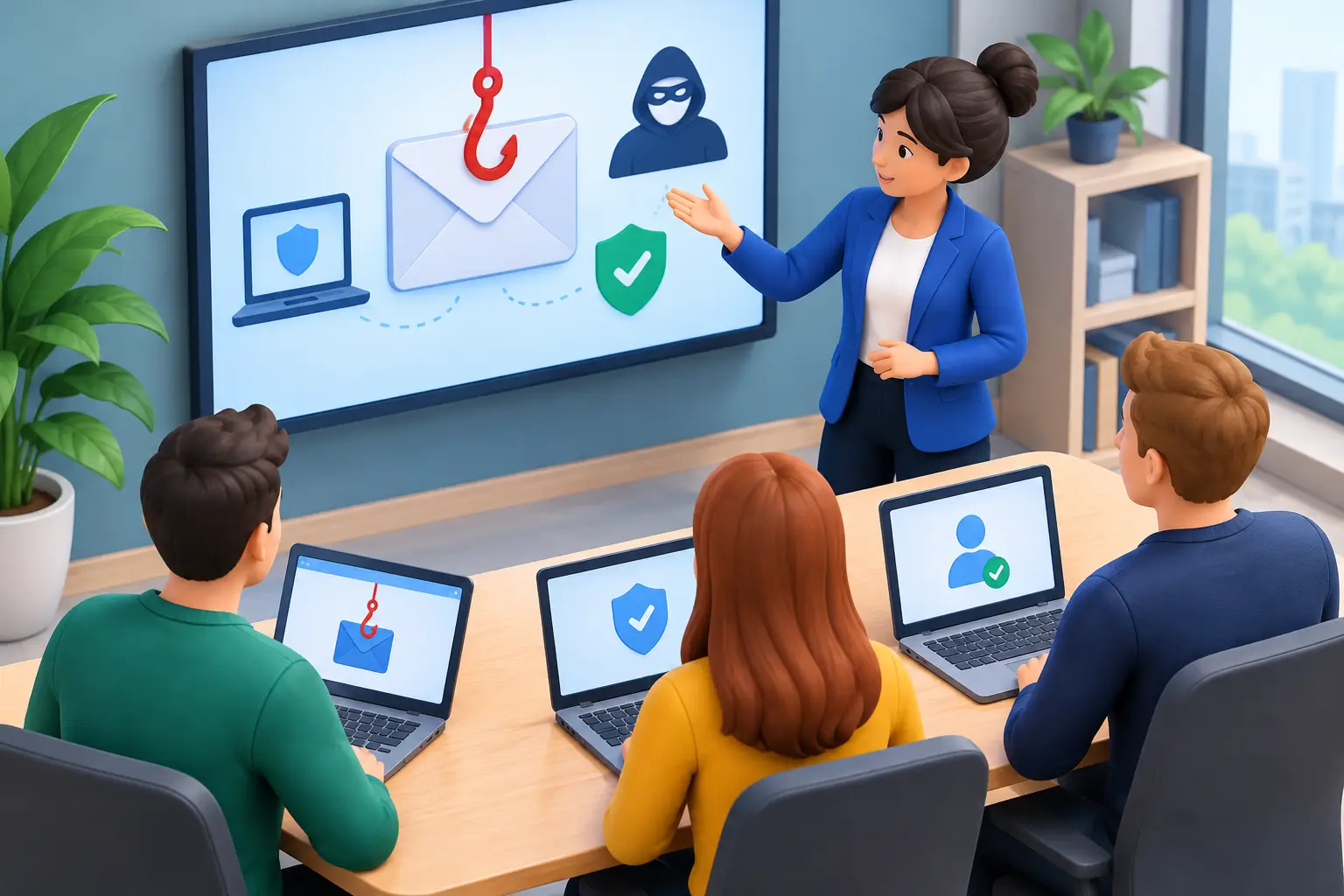
Few, short sessions work better than one large annual presentation. You can cover one example at a time: a fake login page, invoice fraud, QR codes in emails, or messages pretending to come from colleagues. Five to ten minutes regularly can embed important habits better than an hour-long lecture once a year.
New hires should receive security training immediately upon hiring. This should cover what tools the company uses, how passwords are managed, when to use multi-factor authentication, and where to send suspicious messages. If the basic rules are unclear from day one, different working practices will quickly develop between departments.
Training must, however, reflect the role. A receptionist does not need the same examples as an accountant with payment authorisations. Sales staff might receive a phishing email resembling an inquiry from a new client, while a manager might receive a fake request for confidential data. With role-based training, the risks become more understandable and the advice more useful when it matters.
Remote training can be suitable for distributed teams, but it must not become impersonal. Staff need to know who they can contact without delay. A clear service channel to IT or the security team makes it more likely that suspicious messages will be promptly reviewed.
Use simulated attacks fairly
Simulated phishing is a useful tool when used for learning, not for finding culprits. The company then sends a safe, controlled test that resembles a real phishing email and measures whether staff recognise the warning signs, click on a link, or report the message.
Tests alone are not training. If an employee clicks, they need to receive a clear and friendly explanation of which clues should have raised concern and what they should do next. The goal is not to achieve a high pass rate on the test. The goal is to increase the number of those who stop, verify, and report.
The implementation must strike the right balance. Tests that are too easy provide false reassurance, while tests that are too difficult or too frequent can create suspicion and fatigue. Frequency depends on risk, company size, and the nature of the activity. Companies dealing with payments, health information, or personally identifiable data generally require more frequent and targeted exercises than teams with limited access to sensitive systems.
Make reporting simple and fast
An employee who suspects phishing should not have to read a long procedure to know what to do. The process needs to be simple: do not click further, do not delete the message immediately, report it via the approved channel, and wait for instructions if they have already responded.
If a link has been clicked or a password entered, speed is more important than an awkward silence. An employee should be able to report without fear of repercussions. The IT team can then check logins, revoke sessions, reset passwords, see if others have received the same message, and take appropriate action.
Reports are also valuable information about what is happening in the environment. If several employees receive the same fake payment request, the company can warn others before damage occurs. This way, each report becomes part of a collective defence.
Measure behaviour, not just course completion
It is easy to count how many have completed training material. It is more difficult, but much more useful, to measure whether behaviour changes. The proportion of reports from simulated exercises, recurring risk patterns between departments, and the time elapsed from suspicion until IT receives a report can be monitored.
The numbers must be read in context. A higher proportion of reports can be a positive sign of increased security awareness, not an indication of more attacks. Likewise, a single click rate does not tell the whole story. An employee who clicks but reports immediately has helped the company respond faster.
Training alone is not sufficient. It must work in conjunction with technical and operational defences: multi-factor authentication, secure password management, updated devices, limited access privileges, backups, and clear payment processes. If one defence fails, others should mitigate the consequences.
At nexIT, we view security education as part of daily operations, not an annual task to be ticked off. The right combination of training, monitoring, and support helps staff make better decisions without slowing down their work.
The most secure company is not the one that never receives scam emails. It is the company where staff recognise the threat, know exactly where to go, and receive quick, professional responses when they do.